


.jpg)
.jpg)
Themes in the St. Augustine Mysteries--Fallen Angels Vs. Fallen Humans (I)
- Rebecca Imre
- Jan 25
- 3 min read

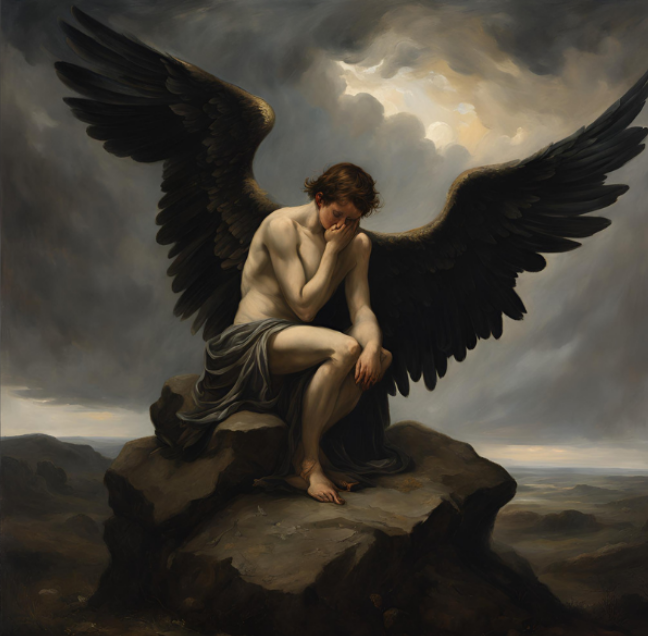
One of the questions often asked about evil in our world is whether real danger comes from fallen angels or from fallen humans.
The answer is uncomfortable: both exist, but they are not equivalent threats.
Fallen Angels: Corruption Without Redemption
In the Bible (and in the world of the Angels Trilogy), fallen angels are ancient beings. They do not experience doubt, fatigue, or moral confusion the way humans do. Once fallen, they do not repent. Their nature is fixed. According to St. Augustine in The City of God, fallen angels are irredeemable because when they fell, they had the full knowledge of what their rebellion meant. Man, on the other hand, was ignorant of the true consequences of rebellion. Therefore, God offered man redemption in a way that He could never offer the angels.
This matters because it shapes how evil operates.
Fallen angels in this series do not appear as monsters or spectacle-driven villains. You won't find demons crawling across the ceiling, black wings fluttering and sharp teeth grinning at helpless mortals in the throes of sleep paralysis. In fact, you never see the demons at all--only their human manifestations.
Rather than act autonomously, they act as pressure systems—subtle, patient, and strategic. They influence environments, encourage rationalizations, and exploit existing cracks in human character.
They do not force people to commit evil.They invite it.
Their power lies not in domination, but in endurance. They wait. They repeat. They study human weakness across generations.
In this sense, fallen angels are not the story’s main actors. They are the background gravity that bends human choices over time. As Sarah says in the upcoming In the Dreams of Angels, "He always comes to me in my dreams; that’s how he always talks to me. But I remember how it was the last time. He needs humans to do his dirty work for him, and he always finds them."
Fallen Humans: Moral Collapse in Real Time
Humans, in contrast to demons, fall differently.
Human evil in the St. Augustine Mysteries is messy, emotional, and often rooted in fear, grief, obsession, or wounded pride. These characters still possess free will. They still experience guilt. They still make choices—sometimes terrible ones—under pressure.
This is why the series spends far more time inside human motivations than supernatural mechanics.
A fallen human may begin with a rationalization:
Just this once.
I had no choice.
It was necessary.
Anyone would have done the same.
Or, worst of all:
I did it from love, not hate.
What makes human evil more dangerous than angelic influence is not its power, but its plausibility. Human characters convince themselves they are justified. They blur moral lines. They adapt.
And unlike fallen angels, humans can still turn back—even if they don’t.
Why Angels Don’t “Fix” Anything
I made a very deliberate choice in this series: angels do not arrive to solve problems.
There is no moment where divine intervention wipes away consequences or overrides human responsibility. Supernatural forces reveal truth; they do not repair damage.
This aligns with the series’ core view of spiritual warfare: evil exposes what is already present in the human heart, rather than creating something new.
Father O'Brian, a central character in In the Realm of Angels, explains that the ordinary work of the enemy is to tempt, not to override human will. If a character collapses morally, it is because something inside him or her was already vulnerable. The pressure applied by the spirit simply brings it to the surface.
St. Augustine as the Perfect Setting
I also made another deliberate choice in placing the series in St. Augustine. Because of its unique history, the city itself reinforces the theme of fallen humans and fallen angels.
As the oldest city in the United States, St. Augustine carries a huge trunk full of faith, conquest, ambition, devotion, and violence. It is a place where the sacred and the corrupt have coexisted for centuries. That makes it fertile ground for stories where ancient influence meets modern moral choice.
The city provides a backdrop for everything that happens--and nothing seems implausible in this magical place. Memory—like evil—has a long reach.
The Real Question the Series Asks
Ultimately, the St. Augustine Mysteries are not asking whether fallen angels exist. I believe they do, and I believe they surround us at every moment, looking for ways in.
However, I do not believe they have unfettered control over us. Instead, they have something far more unsettling: a truth that mankind has proven over and over.
If faced with enough pressure, enough fear, enough loss, there is no limit to how far an ordinary person can fall without the support of faith.
Fallen angels may influence the world, but fallen humans are the ones who act in it.
And that is where the real danger lies.


Comments